How does AI contract analysis reduce business risk?
Discover how AI contract analysis helps technical SMEs reduce failure costs, handle Wkb compliance, and review standard terms like UAV 2012 in minutes.
 Jack van der Vall 6 min read
In this article
TL;DR: Nearly 40% of Dutch construction and real estate companies estimate failure costs at 5%+, often due to contractual clarity issues, while MKB entrepreneurs spend over 40% of their week on admin. AI contract analysis uses multi-agent systems to automatically review documents against standards like UAV 2012, Metaalunievoorwaarden, and the Wkb. In a real-world analysis of 35 contracts, the system caught 410 deviations, including 181 critical or high risks (45 critical), and made review 85% faster than manual checking.
Last updated: 23 July 2026 · By Jack van der Vall, AI Engineer
Related reading: compare this with how to analyze a construction contract with AI, how to prevent additional work disputes under UAV 2012, and our services for contract and document workflows.
The financial impact of contractual oversights
AI-powered contract analysis transforms how technical companies handle document review. Instead of spending hours manually checking each contract, quote, or proposal, multi-agent AI systems can identify risks and deviations in minutes.
The cost of missing a detail is significant. According to research by ABN AMRO via Risk en Business, nearly four out of ten companies in the Dutch construction and real estate sector estimate their failure costs (faalkosten) to be 5% or more—amounting to billions of euros annually. Much of this stems from poor cooperation and communication, often rooted in misaligned contractual expectations.
Furthermore, a 2025 Accountant.nl report highlighted that over 41% of Dutch entrepreneurs spend 50% or more of their workweek on administrative tasks, illustrating the heavy burden of manual document review.
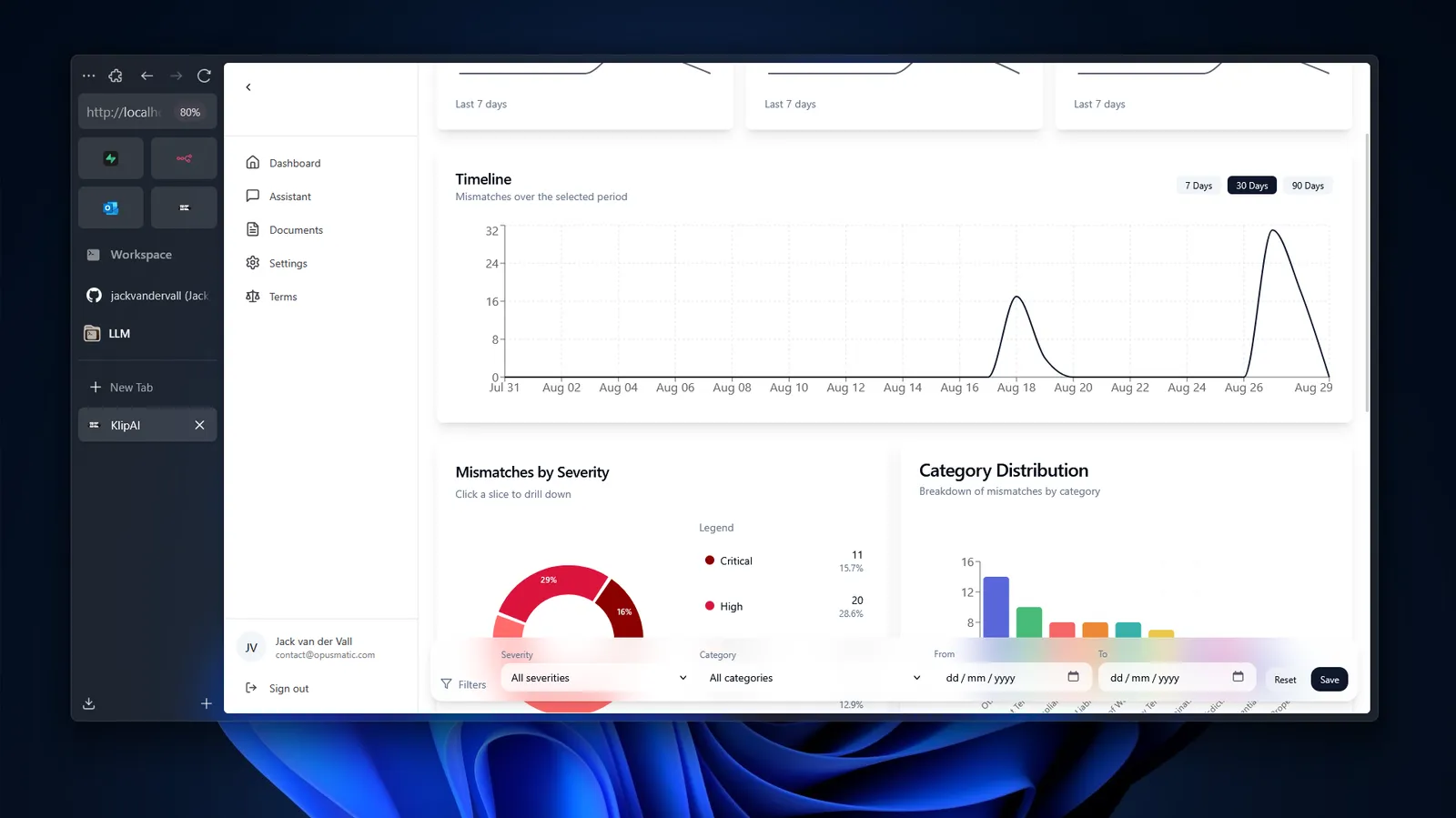
Real-world Value & Performance Tracking (35 Evaluated Contracts):
- 410 total deviations: identified (an average of over 10 deviations per contract).
- 45 Critical risks: caught (including 100% liability shifts, unauthorized foreign jurisdictions, and rejection of FME-CWM protection).
- 136 High-impact risks: flagged (including un-capped delay penalties and hidden DDP shipping costs), heavily concentrated in scope of work and payment terms.
- 85% faster review: a manual check of roughly 2 hours becomes a quick scan of pre-flagged risks.
- Immediate ROI: approximately €10,200 in direct labor savings (85% of some 80 review hours, at conservative €150/hr legal rates).
Raw data available: Contract Analysis Benchmark 2026
What is AI Contract Analysis?
AI contract analysis refers to the use of artificial intelligence—specifically multi-agent systems—to automatically review, understand, and extract insights from business documents.
Unlike simple keyword matching, modern AI systems understand context. They can identify when a delivery term deviates from standard industry conditions, such as the Metaalunievoorwaarden or ALIB 2024, even if the wording is entirely new.
Multi-agent architecture
The system utilizes a multi-agent architecture where a central orchestrator routes user requests to specialized agents:
graph TD
    A[Document Upload] -->|PDF/DOCX/Image| B(PDF Tool Agent)
    B -->|Extracted Text| C{Orchestrator}
    C -->|Compliance Check| D[Compliance Validator]
    C -->|Risk Analysis| E[Risk Assessor]
    D -->|Industry Terms| F[(Standards DB)]
    D -->|Business Rules| G[(Compliance Checklists)]
    E -->|Severity Score| H[Dashboard]
    D -->|Validation Result| H
    H -->|Low to Crucial| I[Human Review]
Accessible text description: The contract is uploaded as a document, converted to searchable text via OCR by the PDF Tool Agent, split and checked by a Compliance Validator and Risk Assessor against industry standard databases. The final step is always an aggregated human review on a dashboard.
Navigating Dutch regulatory frameworks with AI
For technical installation companies, contract review is often a bottleneck fraught with liability traps. Manual review is time-consuming and error-prone, but incorporating AI allows for rapid validation against core Dutch legal frameworks.
The impact of the Wkb (Wet kwaliteitsborging voor het bouwen)
The Wkb significantly shifts liability and documentation requirements in construction.
- Documentation (Dossier Bevoegd Gezag): AI can automatically categorize and verify project documentation (permits, drawings, test reports) to ensure a complete and Wkb-compliant dossier.
- Duty to Warn (Waarschuwingsplicht): AI flags contract clauses or project specifications containing obvious errors, triggering the contractor’s enhanced waarschuwingsplicht and ensuring warnings are proactively documented.
- Latent Defects Liability: The Wkb extends contractor liability for structural defects discovered after delivery (Article 7:758(4) BW). AI checks if incoming contracts attempt to bypass this, preventing an SME from mistakenly accepting massive liability for latent defects years down the line.
Verifying standard conditions (Metaalunievoorwaarden, UAV 2012)
AI can ingest standard terms and compare them against incoming documents to highlight deviations:
- Liability Caps vs. Exoneration Clauses: If an SME fails to explicitly include the Metaalunievoorwaarden exoneration clauses, or if a client’s terms override them, the SME could face unlimited liability for damages. AI catches these missing or overridden clauses before a contract is signed.
- UAV 2012 Delivery Terms: If an SME’s contract is based on UAV 2012 but doesn’t explicitly address the Wkb’s stricter liability for defects post-delivery, the SME is at risk. AI ensures the correct versions (e.g., ALIB 2024 vs older iterations) are being enforced and flags discrepancies.
Validation sources
The AI validates documents against these core sources:
graph LR
    A[Incoming Document] --> B{AI Analysis}
    B --> C[Industry Standard Conditions]
    B --> D[Internal Compliance Checklists]
    B --> E[Commercial Risk Logic]
    C --> F[UAV 2012, ALIB 2024, Metaalunievoorwaarden]
    D --> G[Wkb documentation requirements]
    E --> H[Price validity, liability caps, etc.]
Frequently asked questions
How do you automatically check liability limits in UAV 2012 contracts using AI, considering the Wkb?
AI-driven contract analysis scans contracts for clauses deviating from Paragraph 12 of the UAV 2012 and additional Wkb liability provisions (Article 7:758(4) BW). The system flags deviating liability limits or exclusions that don’t comply with the semi-mandatory nature of the Wkb, enabling manual review and negotiation.
Why does OCR struggle to read signed Metaalunievoorwaarden, and how can this be improved for AI analysis?
OCR (Optical Character Recognition) can struggle with variations in fonts, signatures, stamps, or low resolution on scanned Metaalunievoorwaarden. Improvement requires advanced OCR engines with machine learning, document pre-processing (like de-skewing and noise reduction), and training AI models on datasets of similar documents.
Which AI tools can automatically check the duty to warn (waarschuwingsplicht) according to Wkb in purchasing contracts?
AI tools with Natural Language Processing (NLP) analyze contracts for missing or insufficient warning clauses related to the Wkb’s strengthened duty to warn (Article 7:754 BW). These tools proactively identify risks in specifications requiring a warning and monitor compliance.
Key takeaways
- Failure costs reach into the billions annually in the Dutch construction sector; AI contract analysis mitigates this by catching risk points early.
- Multi-agent AI systems leverage OCR, Compliance, and Risk agents to generate up to €13,500 in labor savings per average batch of 34 complex contracts.
- The technology automatically cross-references documents with Wkb requirements, UAV 2012, ALIB 2024, and Metaalunievoorwaarden.
- Missing an exoneration clause can trigger unlimited liability; in a recent batch, the AI successfully caught 45 critical risk shifts including FME-CWM rejection and foreign jurisdictions.
About the author
Jack van der Vall is an AI Engineer at Opusmatic, specializing in AI automation for technical installation companies and SMEs in South Holland. He develops systems that make complex contract analysis accessible to companies without their own legal department.
Try the contract analysis demo
See how the system checks agreements, flags deviations, and answers questions about contracts.
Contract analysis
Plot D3 — Havenkwartier Zuid
How can I assist you today?
Ask a question, analyze documents, or compare purchasing terms and contracts against your quote.
Read next

How Do You Build an Automated B2B Lead Generator for Technical Installation Companies?
A 6-stage pipeline architecture for automated B2B lead generation, from geo-targeted scraping to verified contact delivery, built for Dutch technical installation and engineering firms.
How to Prevent Additional Work Disputes and the UAV 2012?
Take back control over your project margins. Learn how to prevent additional work disputes by combining UAV 2012 rules with smart data architecture.

How to analyze a construction contract with AI in under 10 minutes
Learn how AI-powered contract analysis screens Dutch construction contracts for risks in under 10 minutes, from UAV 2012 deviations to hidden liability clauses in Metaalunievoorwaarden.
Talk through your process
Tell us which work takes time or leads to errors. In a 30-minute call, we will look at where automation could help.